Bible Buried in the Washington Monument Cornerstone
The Lost SymbolThe Bible Buried in the Washington Monument Cornerstone is the hidden physical referent of the Lost Word in The Lost Symbol. Peter Solomon reveals that a single Bible was enclosed in the Washington Monument’s cornerstone during a Masonic ritual on July 4, 1848. The book is not recovered or opened: it remains underground, while its meaning emerges through the characters’ debate over sacred texts, secrecy, and the difference between possessing a symbol and understanding it.
The object beneath the monument
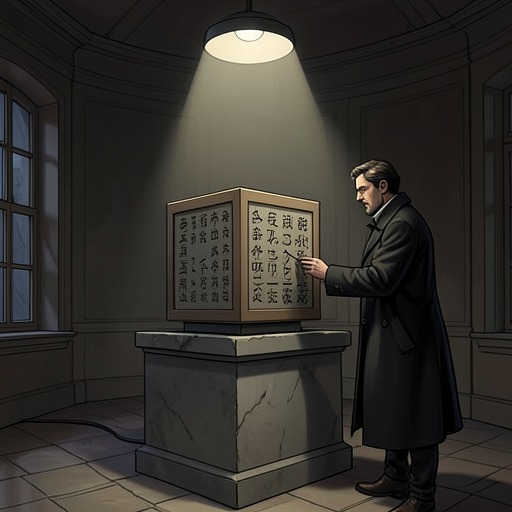
Peter explains that the stone cube Robert Langdon has carried resembles a cornerstone, then describes the tradition of placing meaningful objects in hollow cornerstones as talismans for a building’s future. The Washington Monument’s own cornerstone, he says, contains the Lost Word: a Bible buried there by Masonic forebears in a full ritual on July 4, 1848. His revelation gives the night’s abstract pursuit a precise location and a material form, even as the object itself remains beyond reach.
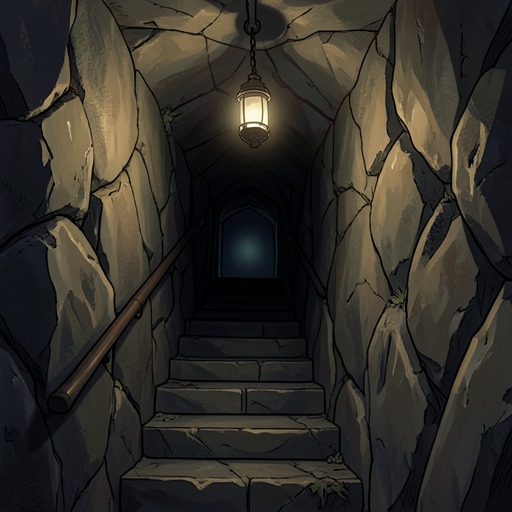
The physical setting reinforces the distinction between the hidden book and the clue that leads to it. Langdon and Peter descend the monument’s winding staircase, which has 896 stone steps spiraling around an open elevator shaft. On the way, Peter illuminates a wall medallion showing a cloaked figure with a scythe and hourglass pointing toward an open Bible. The image directs attention to the book, but does not disclose its contents or provide access to the buried cornerstone. The Bible’s presence is asserted by Peter and signaled through imagery; it is never brought into the light.
From a hidden portal to a buried book
The Bible’s significance resolves a chain of competing interpretations. Earlier, Langdon tells Inoue Sato that the supposed portal to the Ancient Mysteries is best understood as a metaphor for transformation, not a literal entrance hidden in Washington. He treats the hand presented as an invitation and the language of portals as symbolic constructs associated with passage into enlightenment. His skepticism extends to claims that ancient knowledge grants supernatural human powers: he acknowledges the historical abundance of mystical traditions and their documents, but says he has seen no evidence that their extraordinary promises are real.
The chamber’s VITRIOL inscription offers another ambiguous sign. Langdon explains its alchemical maxim as a call to enter the earth and find the hidden stone. He notes that different traditions identify that stone with different sources of power or enlightenment, while those searching for a hidden pyramid might connect it to the pyramid itself. The inscription does not settle the matter. Instead, it makes interpretation part of the search: the same phrase can point toward a physical object, an alchemical ideal, or concealed teachings.
When Langdon and Katherine Solomon explain the decoded pyramid to Dean Galloway, the phrase Jeova Sanctus Unus and the capstone inscription, The secret hides within The Order, have yielded no geographic destination. The pyramid appears to be a metaphorical map rather than a conventional one. Peter’s account of the cornerstone redirects that symbolic trail without abandoning its symbolism: the Lost Word is indeed buried, but what has been buried is a book, not a single magical formula that Langdon can extract from a map.
The Word as a collection of teachings
Peter rejects Langdon’s expectation that the Lost Word must be one word in the ordinary sense. In the beginning was the Word, he explains, and the term names something carried through written teachings rather than a lone cipher. This reframes the Bible in the cornerstone: it is a particular physical volume, but its importance lies in the wisdom represented by the book and the larger body of enduring texts to which it belongs.
Dean Galloway’s reflections extend that idea beyond the monument. In his account, the ancient masters’ teachings have survived in books, and cultures preserve their own sacred volumes: the Bible, the Koran, the Torah, and the Vedas. His own Masonic Bible contains both Testaments and Masonic philosophical writings, illustrating how a book can gather multiple strands of religious and philosophical instruction. This copy is not identified as the buried Bible; rather, Galloway’s thoughts establish the interpretive framework through which the hidden volume can be understood as one instance of a wider textual inheritance.
Peter similarly argues that the Bible and the Ancient Mysteries are not opposites. He sees the Bible’s parables and obscured sayings as a way secret wisdom has been transmitted, and describes enduring texts including the Bible, the Bhagavad Gita, and the Koran as expressing a shared message. He invokes teachings associated with Buddha and Jesus to support the idea that divinity is within humanity. These are Peter’s interpretations, not a discovery made by opening the buried book; the story preserves a distinction between his conviction and the material evidence available to Langdon.
Inaccessibility and narrative significance
At the monument’s base, Peter makes clear that the Bible cannot be accessed: it lies underground inside the cornerstone. Langdon accepts Peter’s assurance that it is there, but his attention turns to the plaza’s pattern of white stone interrupted by two concentric circles of darker stone. The scene ends not with the Bible’s recovery, but with another visual clue drawing Langdon’s scrutiny. The buried volume remains a destination in thought and interpretation, not an artifact the characters can inspect.
That inaccessibility gives the book its double force. The search begins under pressure to locate a secret that the captor imagines as hidden power; Langdon repeatedly resists treating metaphor as literal fact. The solution does bring the search to a real buried object, yet Peter’s explanation denies the expected spectacle of a key that can simply be taken out and used. The Bible becomes a vessel for inherited wisdom whose presence is tangible but whose meaning requires sustained reading. By making the Lost Word both materially buried and conceptually distributed across enduring texts, the novel turns concealment from a puzzle of location into a question of interpretation.